UnlockSweden
· Guides · 16 min read
Rail Biking in Sweden
A practical guide to rail biking (cykla dressin) in Sweden. Covers the season, 14 tracks with maps and booking links, prices, logistics, and safety. Pedal a cart on disused railways through forests and lakes — no cars, no junctions, no balance needed. From half-day family rides to overnight micro-tours. Prices current as of July 2026.
Contents
- How it works
- Season
- Where to ride: tracks north to south
- Prices
- Where to find information
- Fitness: rail bike vs regular bicycle
- What to pack
- Logistics: how to get there
- Safety rules
- Other things worth knowing
- Mini dictionary
- Useful from other guides
- Useful links
How it works
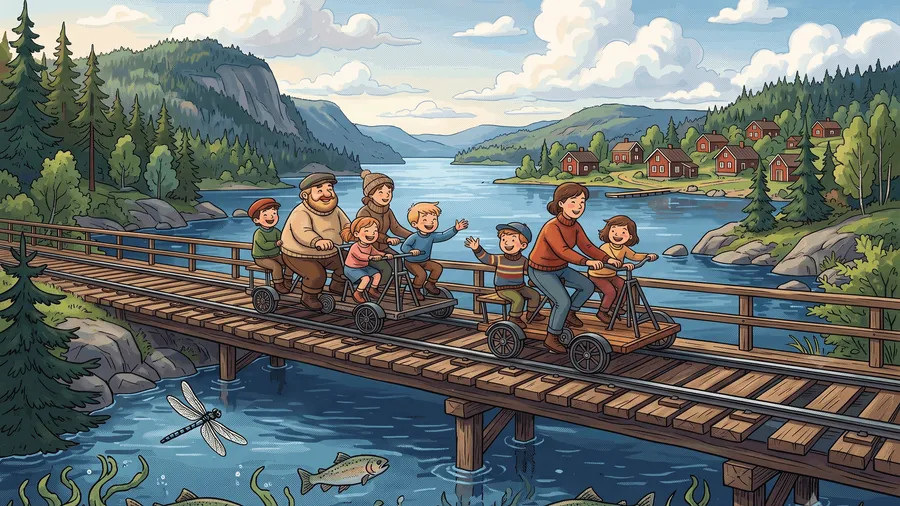
- Where it comes from: Sweden has dozens of closed railways (nedlagda järnvägar). Volunteer societies and local councils kept the rails and now rent out rail bikes — usually from an old station building. It is grassroots cultural and tourism infrastructure, like community cross-country ski trails in winter.
- Types of rail bikes: enkeldressin (~60 kg) — one person pedals, the other sits on the bench; tandemdressin (~90 kg) — two people pedal, a third is a passenger. A small child (up to ~6 years) fits on the bench next to an adult. Some places have special models: a platform for a wheelchair and a cage for a dog (Österlen).
- The main rule: you return the rail bike to the same station where you picked it up. All routes are there-and-back: you go as far as you want or can, then turn around and ride back. It is easiest to turn at a vändplats — special turning points marked with “Vänd dressin” signs. Between turning points, you lift the rail bike off the rails and turn it by hand, or swap with oncoming riders.
- Speed — a comfortable ~10 km/h. In half a day (4 h) you can do 15–25 km with swimming and fika; in a full day, 30–50 km.
- Oncoming rail bikes: there is only one track, no passing loops. One crew lifts their rail bike off the rails to let the other pass (easier with two people), or crews swap rail bikes — both still have to turn around, but you do not need to carry the bike off the track and put it back after the other passes.
- Start slots: many rentals send everyone out at the same time in the same direction (for example, Hultsfred uses fixed start times to keep oncoming traffic low). If you are late, you lose your slot.
Season
Rail biking is a snow-free activity: tracks open “when the snow is gone and the line is passable” and close in autumn.
| Period | What happens |
|---|---|
| April | The south opens: Romeleåsen in Skåne runs daily from April. The rest of the country is still closed |
| May | Mass opening: Dellenbanan from 1 May, Station Sågen from 15 May, Hagfors from May, Degerfors — low season from 5 May. Mostly pre-booked or weekends only |
| June–mid-August | High season: daily operation and drop-in almost everywhere (DVVJ — 8/6–22/8, SSJF — 26/6–17/8, Smalspåret — 17/6–16/8). July slots fill up fast |
| Late August–September | Quiet golden season: Dellenbanan until 30/9, Romeleåsen until October; many switch to weekends and pre-booking |
| October | Last tracks: Station Sågen until 17/10, Österlen — weekends, DVVJ opens extra days for höstlov (week 44) |
| November–March | Closed nationwide |
📅 Book ahead: in July and early August, rail bikes on popular tracks (Smalspåret, DVVJ, Dellenbanan, Österlen) sell out days in advance — each station has only 10–30 rail bikes. In autumn and spring, the opposite: often phone booking only.
Where to ride: tracks north to south
| Place (region) | Route / km | Starting point | Why it is interesting | Links |
|---|---|---|---|---|
| Dellenbanan, Delsbo (Hälsingland) | Hudiksvall–Hybo, up to 54 km | Delsbo Station | The longest network in the country: the Dellen lakes, bridges, tunnels; drop-in in summer | Site · Map |
| Vansbroäventyr (Dalarna) | Inlandsbanan from Dalasågen, ~15 km | Dalasågen (Vansbro) · Vika (Mora) | The legendary Inlandsbanan along the Vanån river and Vansjön lake: beaches, log shelters, beaver safari; day and 24-hour tours | Site |
| Station Sågen (Dalarna) | Inlandsbanan, 30 km south of Vansbro | Station Sågen | ”Outdoor på spåret”: hourly rental, packages with overnight stay at the old station, season until mid-October | Site |
| Hagfors Järnvägsmuseum (Värmland) | Hagfors–Stjärnsfors, 12 km RT | Hagfors Railway Museum | Rail bike from the railway museum along Lake Värmullen; combine with the museum visit | Site · Route |
| DVVJ, Bengtsfors–Årjäng (Dalsland/Värmland) | 50 km | Bengtsfors Station · Kyrkerud (Årjäng) — Kyrkerud summer only | ”De vackra vyernas järnväg” — the country’s most famous track: forest lakes, swimming, a kiosk at Kråkviken, shops in Gustavsfors; day, evening, and 24-hour rental; combo with canoe (packages at dvvj.se) | Site · Route |
| Joytrail, Svanskogsbanan (Åmål, Dalsland) | Forsbackabaden–Svanskog, 15 km one way | Forsbackabaden (Åmål) | Forest lakes and the 263-metre Bollsbytunneln tunnel; museum station Svanskog with a café carriage and overnight stays in a sleeper car; single rail bikes only; phone booking only; combo with canoe on the Dalsland–Nordmarken system | Site · Route |
| Trelänsbanan + Torvedsbanan (Degerfors / Gullspång) | up to 65 km | Ängebäck (Degerfors) · Gullspång; Konsterud (Kristinehamn) closed | The former Nora Bergslags Järnväg across three counties (Örebro–Värmland–Västra Götaland): Gullspång salmon ladder, track-keeper cottages, simple overnight stays by the track | Degerfors · Gullspång · Route |
| Ambjörnarp–Sjötofta (Tranemo, Västra Götaland) | 7 km | Ambjörnarp Station | A short family track run by a village society (byalag): lakes, rastplats Holmåkra with swimming; online booking, low season — some weekends only | Site |
| Smalspåret, Hultsfred / Virserum (Småland) | 12 km Hultsfred–Målilla; 29 km Virserum–Åseda | Hultsfred Station · Virserum Station | A living 891 mm narrow-gauge railway: Virserum station in 1950s style, café Tre Systrar, swimming at Hesjön; on Saturdays in July–August, heritage trains run on Virserum–Åseda — rail bikes are redirected | Site · Route |
| SSJF, Strömsnäsbruk (Småland) | 7.5 km to Axhult | Strömsnäsbruk Station | A short classic route with a rest stop at Axhult; two slots a day, simple family logistics | Site |
| Glimminge station (Broby, Skåne) | 12 km RT | Glimminge Station (Broby) | An 1800s station on the Hästveda–Karpalund line; overnight stay in restored railway carriages | Site |
| Veteranjärnvägen, Klippan–Ljungbyhed (Skåne) | Nybygget–Ljungbyhed, 6.5 km (13 km RT) | Nybygget (Klippan) | A family museum track through oak and beech forests; Lilla Kloster site with grills; slots 10:00/13:30/17:00, outside 15/6–30/8 pre-booking only; phone booking only; combo “canoe on Rönne å + rail bike back” | Site · Route |
| Romeleåsens dressincykling (Genarp, Skåne) | Björnstorp–Veberöd (Romeleåsen ridge) | Björnstorp 751 (Genarp) | The longest season (April–October, daily, 3 slots a day); eco-tourism on an ancient ridge, half an hour from Malmö | Site · Map |
| Dressin på Österlen (Tomelilla / Sankt Olof, Skåne) | Tomelilla–Fyledalen; St Olof–Gyllebosjön 14 km RT | Tomelilla (by the folkhögskola) · Sankt Olof; off-season St Olof — mostly weekends | Two tracks across Österlen: the Fyledalen valley with red kites (birds of prey) and farmland, plus swimming in Gyllebosjön; special rail bike for a wheelchair or dog; autumn — weekends only | Site · Route |
The full list of rental operators nationwide — portal cykladressin.se (a joint site of all operators) and the upplevelse.nu catalogue (14 listings with online booking). Note: tracks sometimes close — Konsterud station (Kristinehamn) is not operating, Wadstena–Fogelsta rail bikes have been on pause — check the operator’s website before planning.
Prices
You pay per rail bike (per crew), not per person — Smalspåret is the exception. 2026 figures:
| Place | Format | Price |
|---|---|---|
| Smalspåret | half day (4 h) / full day (8 h) | 250 / 500 SEK per adult, children 7–16 half price, under 6 free |
| SSJF Strömsnäsbruk | slot ~2.5 h | 295 SEK single / 495 SEK tandem |
| Dressin på Österlen | slot 4 h | 370 SEK low season / 390 SEK high season (27/6–16/8); special rail bike 500 SEK |
| Romeleåsen | slot (~4 h) | 400 SEK; whole “train” of 10 rail bikes — 3,000 SEK |
| Hagfors | 12 km tour | 400 SEK |
| Gullspång | half day / full day | 400 / 700 SEK |
| Station Sågen | hour / day | 195 / 600 SEK (tandem up to 3 adults) |
| DVVJ Bengtsfors | day / evening / 24 h | from ~400 SEK single, ~540–550 SEK tandem; 24-hour rental costs more |
Payment notes:
- Almost everywhere it is card or Swish; places like Smalspåret are explicitly kontantfri (cash-free). Swish requires a Swedish bank account — a visitor needs a rental that takes cards or has online payment (DVVJ, Dellenbanan, Ambjörnarp have online booking with payment).
- Vansbroäventyr takes “invoice or Swish” and only pre-books by phone/email — visitors should check the payment method in advance.
- Members of railway societies get discounts (50% at Smalspåret): if you are going as a large group, membership might pay for itself.
Where to find information
- cykladressin.se — a portal of all rail bike rental operators in Sweden: one entry point with links to each operator.
- upplevelse.nu — Åka dressin — a catalogue with filters by region and online booking.
- Regional tourism portals — the most vivid route descriptions: Visit Skåne, Västsverige, Visit Småland, Visit Värmland, Visit Dalarna.
- Articles with track round-ups: turist.se — 5 summer tracks, cabinsinsweden.com.
- Current status (closures, track repairs, free slots) — only the operator’s own website or Facebook: many are volunteer societies, and Facebook gets updated more often than the website.
- Search terms: “cykla dressin”, “hyra dressin”, “dressinuthyrning” + region; in English — “railbike”, “trolley cycling”, “draisine Sweden”.
Fitness: rail bike vs regular bicycle
Short answer: easier than a bicycle in almost every way, except three things — the weight of the machine, no gears, and turning around.
- No balance needed: the rail bike sits on the rails by itself, you cannot fall sideways, you do not need to hold the handlebars. One person pedals, the others ride as passengers — it works for people who cannot ride a bicycle at all, older people, and children.
- Steel-on-steel rolling — friction is many times lower than a tyre on asphalt: on a flat section you can hold 10 km/h without effort. Railways were built with gradients no steeper than ~1–2% — you never get the kind of sharp climbs you get on a bicycle in hilly terrain.
- But the rail bike is heavy (60–90 kg): getting started and long gentle climbs are noticeable, there is only one gear, you cannot shift down. On tracks with a slope, one direction is always slightly uphill (usually the outward leg), the way back is downhill. Operator rule of thumb: ~10 km of pedalling per hour.
- The hardest part is not riding — it is lifting the rail bike off the rails to turn around or let others pass: hard alone, fine with two. At some crossings the rails are covered with asphalt — pushing the rail bike across is noticeably harder than on rails.
- Who can do it: half a day (15–20 km) — any healthy adult and teenagers; you can swap who is pedalling whenever you like. At Smalspåret older children pedal on their own. A full day of 40–50 km (DVVJ, Dellenbanan) is proper physical activity, similar to a light bicycle tour.
- Wind feels stronger than you think: you sit high up, and there is nowhere to hide on the rails — a headwind on open stretches slows you down a lot.
What to pack
- Matsäck — food and a thermos: the core rail bike experience is fika at a rest stop (rastplats). Along the tracks there are stops with tables, fire pits (grillplats), and log shelters — bring korv for the grill; that is exactly what Swedes do. There are almost no shops along the way (exceptions: the kiosk at Kråkviken and Gustavsfors shops on DVVJ, café Tre Systrar on Smalspåret).
- Water — at least 1 litre per person in hot weather: there is little shade on the railway embankment.
- Swimwear and a towel: almost every track passes a badsjö — swimming is built into the route (Gyllebosjön, Hesjön, Holmåkra, Vansjön beaches, DVVJ lakes).
- Work gloves — lifting and turning the rail bike is easier with gloves (some places provide them, but your own are more reliable).
- Insect repellent — mosquitoes in June–July near water and in forests are a must; plus sun protection and a cap: the embankment is an open space.
- Closed, sturdy shoes: you will walk on gravel (ballast) and sleepers — flip-flops are a bad idea.
- Full rain protection, not just a rain jacket: you sit high and open, there are no shelters or covers along the way — if you get caught in rain, you collect all the water on yourself, all the way back to the station (possibly hours of riding). You need a full set: a waterproof jacket with a hood plus rain trousers, and put your things in a dry bag or plastic bags; a light poncho is useless when pedalling. Bookings are usually non-refundable in rain (each operator has its own ombokning policy — read it when booking).
- A bag for rubbish: there are no bins on the tracks; take everything back with you (allemansrätten ethics).
- Phone charged + bank card; a bike helmet does not hurt for children — operators usually do not require them but also do not provide them.
Logistics: how to get there
Rail bike tracks are in deep countryside; a car is easiest, but some are reachable by public transport. The all-in-one planner is resrobot.se.
- Doable without a car: Tomelilla (Österlen) — Pågatåg from Malmö ~1 h, the station is a couple of minutes from the rail bike start; Hultsfred (Smalspåret) — Krösatågen on the Linköping–Kalmar line, start is right at the platform; Degerfors (Trelänsbanan) — station on Värmlandsbanan (Stockholm–Karlstad trains); Delsbo (Dellenbanan) — X-trafik bus from Ljusdal or Hudiksvall station; Strömsnäsbruk (SSJF) — Krösatåg/bus on the Hässleholm–Markaryd line.
- Car only (or with taxi connections): Vansbro and Station Sågen, Bengtsfors (Västtrafik bus from Åmål runs but infrequently), Gullspång, Ambjörnarp, Genarp, Broby.
- Driving distances: from Stockholm — Delsbo ~300 km, Vansbro ~330 km, Hultsfred ~330 km, Degerfors ~250 km, Bengtsfors ~400 km; from Gothenburg — Bengtsfors ~170 km, Gullspång ~180 km, Ambjörnarp ~100 km; from Malmö — Genarp ~25 km, Tomelilla ~65 km, Broby ~95 km, Strömsnäsbruk ~95 km.
- Car rental, parking, and payment details are covered in the guide Practical Guide to Stockholm and Around.
- Remember the “return to the same station” rule: there is no linear logistics of “arrive at A, leave from B” on rail bikes — plan your transport to and from one point.
Safety rules
Taken from operator rules (DVVJ, Romeleåsen, Österlen) — you sign your own version on site:
- Level crossings (vägövergång) — the main danger: before the STOP sign, stop well in advance, everyone gets off, and push the rail bike across the road by hand, one at a time, nobody sits on the rail bike. At busy crossings visibility can be limited — look both ways.
- Distance between rail bikes — at least 20 m: braking distance on steel is long, especially on wet rails.
- Speed — keep ~10 km/h: at joints, branches, and stones on the rails a speeding rail bike derails, and the fall is hard. The track is cleared, but small obstacles are normal; if you see a branch, remove it.
- Downhill sections: brake early, keep oncoming traffic around bends in mind.
- Right of way when meeting is set by the operator (at DVVJ those coming from Årjäng have priority; at Österlen — “whoever is closer to the turning point”) — listen to the briefing.
- Stopping for a long time (swimming, lunch) — lift the rail bike off the rails: others are coming from behind.
- Do not jump onto the rail bike from the back: a rail bike has three points of support — a sudden load on the rear shifts the centre of gravity backwards, the front wheel lifts, and the rail bike derails. Get on and off only when the rail bike is standing still, without jumping.
- Do not go past the route boundary: “Vänd dressin” signs and end points are a firm rule — beyond them there may be live rail traffic or a section of track in unsafe condition.
- Keep hands and feet inside the rail bike, and children’s fingers away from the wheels; a child on the bench — only with an adult.
- On some tracks, heritage trains run on certain days (Virserum–Åseda on Saturdays in July–August) — follow the operator’s detour plan.
Other things worth knowing
- Overnight on the rails — a signature format: 24-hour rental (dygnstur) at DVVJ and Vansbroäventyr, “rail bike + overnight + food” packages at Station Sågen, overnight stays in old carriages at Glimminge Station, simple sites with log shelters along Trelänsbanan. Sleeping bag + rail bike = a micro-tour with no backpack on your back.
- Combo routes: rail bike + canoe in Dalsland (packages at DVVJ), bike tour + rail bike along the Göta Canal (Göta kanal package), museum + rail bike in Hagfors, heritage train + rail bike on Smalspåret.
- Accessibility: Österlen has a special rail bike with a platform for a wheelchair (with a ramp for boarding anywhere along the route); Vansbroäventyr promises help for people with limited mobility on request.
- Dogs: there is no single rule — Österlen has a special rail bike with a cage (90×55×60 cm); at other places ask when booking; a dog usually cannot sit on the bench.
- Groups: rail bikes scale well for groups and team building — Romeleåsen rents out a whole “train” of 10 rail bikes, and most operators take group bookings by email.
- Weather: wet rails = slippery and longer to brake; after thunderstorms there are branches on the track. That said, rail biking is one of the few activities that is still pleasant in drizzle — but only with full rain gear (jacket + trousers, see “What to pack”); the upside is empty tracks.
- Children: up to ~6 years — passenger on the bench with an adult; infants at some operators from 2 years or by arrangement; teenagers pedal on their own. This is one of the most all-ages outdoor activities in Sweden.
Mini dictionary
| Term | Meaning |
|---|---|
| dressin / cykeldressin | rail bike |
| trampa / cykla dressin | to pedal / ride a rail bike |
| enkeldressin / tandemdressin | single (1 pedaller) / tandem (2 pedallers) |
| dressinuthyrning / hyra | rail bike rental / to rent |
| förbokning / drop-in | pre-booking / walk-in |
| bana / banvall | line, track / railway embankment |
| nedlagd järnväg | closed railway |
| smalspår / normalspår | narrow gauge (891 mm) / standard gauge |
| vägövergång / stopplikt | level crossing / mandatory stop |
| vänd dressin / vändplats | ”turn rail bike” (sign) / turning point |
| mötande / företräde | oncoming / right of way |
| rastplats / grillplats / slogbod | rest stop / fire pit / log shelter |
| badsjö / badkläder | swimming lake / swimwear |
| matsäck / fika / grillkorv | packed food / coffee break / grilling sausage |
| halvdag / heldag / dygn | half day / full day / 24 hours |
| högsäsong / lågsäsong | high season / low season |
| urspårning | derailment |
| pass | slot (e.g. “pass 1: 9:00–12:45”) |
| järnvägsförening / byalag | railway society / village society (typical operators) |
Useful from other guides
- Practical Guide to Stockholm and Around: car rental and parking, cash-free Sweden and the Swish trap (you need a Swedish bank account), emergency numbers — all of this is directly relevant to a rail biking trip.
- Hiking & Winter Touring in Sweden: allemansrätten and outdoor ethics (rubbish, fires, overnight stays by the track), matsäck culture, gear for day trips.
- Cross-Country Skiing in Sweden: the same principle of grassroots volunteer infrastructure and the same rule of “check status with the operator, not an aggregator”; resrobot.se and Naturkartan work in summer too — Naturkartan shows rest stops and swimming spots near rail bike tracks.
- Canoeing Rivers and Canals in Sweden: the water half of the “rail bike + canoe” combo — the Dalsland–Nordmarken system (DVVJ, Joytrail) and Rönne å (Veteranjärnvägen) are covered in detail there.
- Bike Touring in Sweden: banvall-leder — the same closed railways, but turned into bike paths; also the “bike + rail bike” combo along the Göta Canal.
Useful links
| Link | Purpose |
|---|---|
| cykladressin.se | Portal of all rail bike operators in Sweden |
| upplevelse.nu — dressin | Rail bike activity catalogue with online booking |
| dvvj.se | DVVJ Bengtsfors–Årjäng: booking, rules, packages |
| dellenbanan.se | Dellenbanan — Sweden’s longest track (54 km) |
| smalsparet.com | Småland narrow-gauge: rail bikes and heritage trains |
| dressin.se | Dressin på Österlen (Skåne) |
| dressincykling.se | Romeleåsen — longest season (Apr–Oct) |
| vansbroevent.se | Rail bikes on the Inlandsbanan (Vansbro/Mora) |
| stationsagen.com | Station Sågen: rail bikes + overnight stays on the Inlandsbanan |
| jvmuseet.se | Museum and rail bikes in Hagfors |
| vanerleden.se — Trelänsbanan | Trelänsbanan Degerfors–Gullspång (65 km) |
| visitskane.com — dressin | Overview of Skåne tracks |
| vastsverige.com — dressin | Overview of West Sweden tracks |
| visitsmaland.se — dressin | Overview of Småland tracks |
| gotakanal.se — package | Bike + rail bike combo along the Göta Canal |
| resrobot.se | Public transport planner |
| naturkartan.se | Rest stops, swimming spots, and trails near rail bike tracks |